
Dust Collectors,
In air pollution control, primary dust collectors are a device for removing large size particles from the air stream. These particles are around 20 microns in diameter and return to the dryer as usable material. The baghouse (secondary dust collector), however, is able to remove much smaller particles.
Here we will show 2 types of primary dust collectors Tarmac offers.
KNOCK OUT BOXES
First, Knock Out Boxes are low efficiency large steel boxes that have a larger cross section area than the dryer diameter, discharge plenum, or the ductwork. An example below shows the Knock Out Box to the left of the baghouse on an asphalt hot mix plant. This plant dries rock/aggregate for use in their asphalt mix.
Efficiency of the Knock Out Box is from 40% to 60% of input fines from 300 mesh to 150 mesh. Asphalt plants use collected fines by reintroducing them into the RAP collar.

CYCLONES
Another option is a cyclone and here is how it works. Dirty air enters the cyclone (primary dust collector) and moves in a circular motion in increasingly tighter circles. Like a fast moving car trying to make a tight curve, the large particles cannot make the turn. Instead they hit the wall and fall to the bottom for collection.
LOW EFFICIENCY CYCLONES
Tarmac also designs and build low efficiency cyclones for mid range collection. Designs on these include a short vertical cylinder and a short cone section. We recommend soil remediation and aggregate use these cyclones.
This cyclone has a 55% to 65% collection efficiency of product from 300 mesh to 150 mesh.
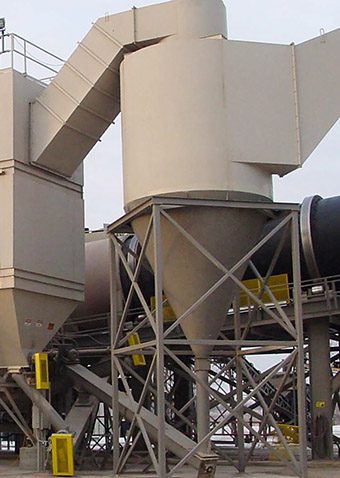
HIGH EFFICIENCY CYCLONES
The high efficiency cyclone has a longer vertical cylinder and longer cone. It has a vortex breaker to keep dust re-entrainment from entering the lower cone. Engineers select the cyclone’s diameter to give the exact proper velocity for excellent fines removal. We often recommend this for soil remediation systems, fine bulk drying, and fine aggregate drying.

The above photo includes discharge augers from both the cyclone on the left and the baghouse on the right. The cyclone collected discharge is far greater than that of the baghouse. Lower fines to the baghouse will allow for fewer bag pulses which extends the life of the bags and less sand impingement wearing on the bags.
OTHER EQUIPMENT DESIGN CONSIDERATIONS
Often the industry does not consider equipment design before the Primary Collector. There are crucial choices for design that will improve primary dust collection and keep pay product removal at the dryer discharge flange and not at the primary collector or the baghouse. Dryer diameter and dryer discharge plenum designs must be considered.
Dryer Diameter: With all other variables held constant, the choice of dryer diameter will increase or decrease the gas velocity within the dyer. Thus the fine material either falls out of the dryer discharge flange or is lifted into the air stream and sent to the primary collector and/or baghouse. The graph below, from the 1961 Barber Greene Drying Principles, gives us an example of a 50% increase in internal dryer gas velocity causing a 125% increase of fines removed from the dryer. Later in this paper maximum gas velocities are given. Tarmac still uses Barber Greene Drying Principles to size dryer diameters for different applications today.
Size of Gas Discharge Plenum: The cross-sectional area of the dryer gas discharge plenum can become a primary collector itself if made large enough. For fine material drying Tarmac sizes the gas discharge plenum cross sectional area at 125% larger than the dryer cross sectional area. Below shows a properly sized frac sand dryer gas discharge plenum.
Conclusions
Making pre-assembled component drying systems complete at the factory lowers freight costs and reduces installation costs. Single source full system design from feed systems, dryer diameter, burner selection, gas discharge plenum design, choice and sizing primary collectors, and the baghouse engineering gives our Customer’s a balanced drying system under one OEM’s responsibility. Tarmac pre-assembles equipment to provide reduced freight cost. Additionally, this aids the ease and speed of installation, this is especially helpful if there is a tight time-line for commissioning.
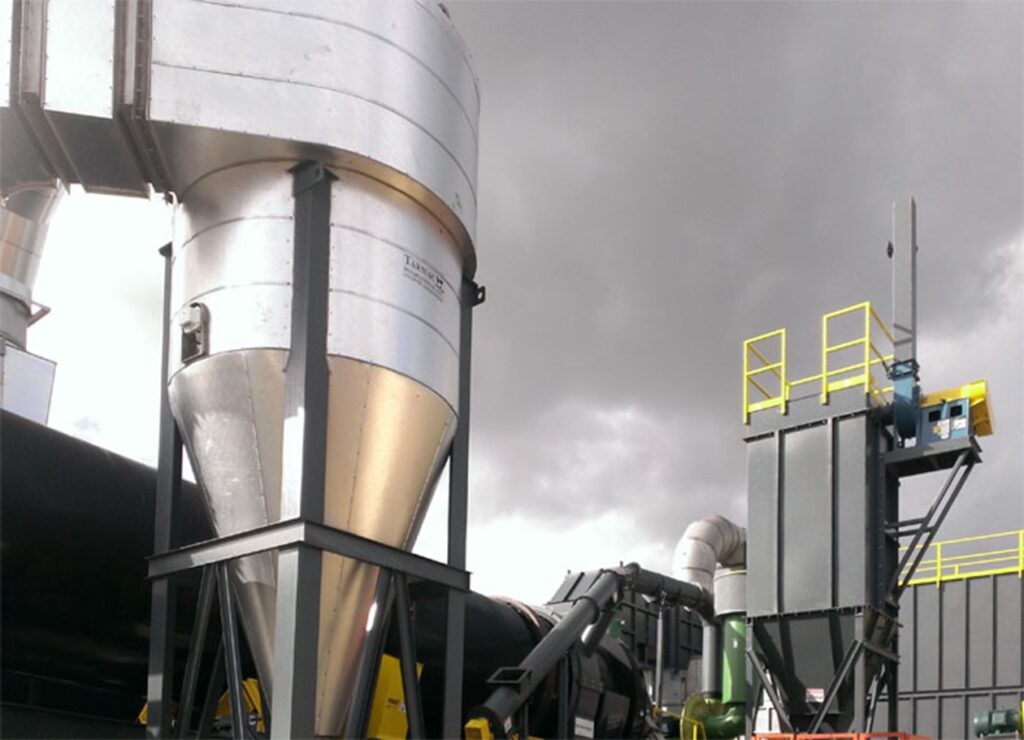
This high efficiency cyclone is part of a frac sand drying plant and has reached 90 – 95% efficiency.
Will a cyclone improve your process and therefore your bottom line? Give us a call.