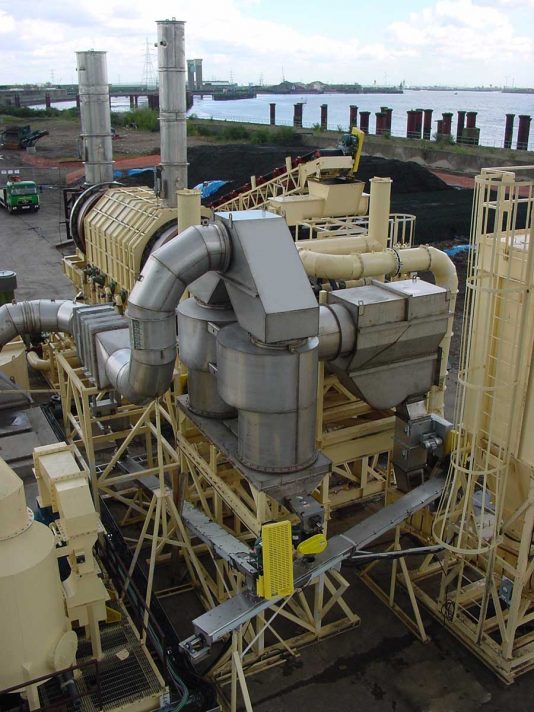
Tarmac Indirect Fired Remediation Specifications
| Production In US TPH | Dryer Diameter | BTU Required in MM BTU/HR Dryer | Method of Oil Recovery |
|---|---|---|---|
| 3 – 4 | 7′ (2.13 M) | 8 | Condensing |
| 7 – 10 | 8.75’ (2.67 M) | 30 | Condensing |
Assumes 600°F (315°C) soil discharge temperature and 1,562°F (850°C) in Oxidizer
10 -15% Moisture Removal by Total Weight
Tarmac is continually growing and evolving. Take a look at some of the recent improvements to our design. Let us know if you have special needs or ideas for improvements as well!
Review Thermal Soil RemidiationTarmac Indirect Fired Remediation Specifications
| Production In US TPH | Dryer Diameter | BTU Required in MM BTU/HR Dryer | Method of Oil Recovery |
|---|---|---|---|
| 3 – 4 | 7′ (2.13 M) | 8 | Condensing |
| 7 – 10 | 8.75’ (2.67 M) | 30 | Condensing |
Assumes 600°F (315°C) soil discharge temperature and 1,562°F (850°C) in Oxidizer
10 -15% Moisture Removal by Total Weight
Tarmac is continually growing and evolving. Take a look at some of the recent improvements to our design. Let us know if you have special needs or ideas for improvements as well!
Review Thermal Soil RemediationKeep Your Product Out Of Direct Contact With The Dryer Flame
Tarmac Indirect Fired Remediation Equipment
Indirect fired remediation equipment is used for soils with hydrocarbons well over 6% by total weight. If you have drill cuttings, for example, you will have 20 to 30% oil by weight with a mixture of number 2 oil and crude. If you have old pits from exploration, you could have 20% oil by weight and even more crude fractions.
When a project requires the gas flow within the dryer (superheated steam and hydrocarbons) to be separate from the dryer’s heat source, there can be two common reasons:
- For permit reasons, specific contaminants (such as chlorinated compounds) must be out of direct contact with the dryer flame or
- The hydrocarbon content is too high within the soil (such as 300,000 PPM oil-based drill cutting).
1.
The gas flow leaves the dryer and is directed first to a high efficiency cyclone.
2.
The second step is an oil or water hydroclone, and finally a venturi wet scrubber.
3.
The hydroclone drops the gas temperature, may correct for Ph, and drops out the oil (water).
4.
An oxidizer can be added for final hydrocarbon reduction in the gas flow.
Indirect Fired Dryers can be used for:
- Fly ash to remove moisture and carbon
- Platinum Group Metals
- General Mineral Processing
- Oily Mill Scale
- Pyro-processing
- Bulk Drying with Inert Atmosphere
- Catalysts
- Soils with high hydrocarbon contamination
- Soils with PCB contamination