
Aggregate Drying, Drums & Dryers, Rotary Dryers,
Dryer Selection: Counter flow vs Parallel flow
How do Tarmac’s engineers determine when to use Parallel Flow (Co-Current) or Counter Flow (Counter-Current) thermal rotary dryer design? Dryer selection comes in typical rules for the dryer type choice. However, we can modify these rules if our customer has specific drying needs.
Simply stated, thermal rotary dryers are rotating cylinders that continuously bring wet solids into the dryer shell and discharge those solids dried and at a higher temperature. The method of heat transfer is convection: passing heated gas around the solids in the dryer to dry the solids. This increases the solid’s temperature.
Direct fired rotary dryers are the most fuel efficient dryers available. Tarmac uses direct rotary dryers most often due to the fuel cost savings, if gas temperature and solids size allows. Proof of the efficiency of the dryer is the gas temperature at the discharge gas end of the dryer. The lower the gas discharge temperature the more efficient the dryer.
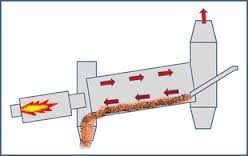
COUNTER FLOW DRYERS
As in the above drawing, the burner is low and at the solids discharge end. The material enters at the high end of the dryer and proceeds down to the burner / material discharge temperature. Or, said another way, more heat is removed from the dryer gas flow and imparted to the solids in a counter flow dryer than a parallel flow dryer.
Counter Flow Dryers allow for a longer retention time for the particles to be dried.
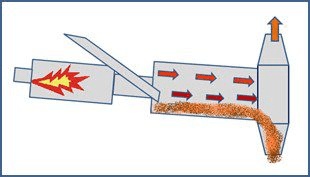
PARALLEL FLOW DRYERS
Gas temperatures can approach the solids discharge temperature but never fall below that, unless air is added to reduce the gas discharge temperature. (Read more about that here). This may work best for two reasons:
(a) The solids discharge temperature is low and the dryer needs to use a baghouse for dust collection. The baghouse cannot have gas temperatures enter that allow water droplets and dust to combine in the baghouse. This “muds” the bags. Then workers shut down the baghouse to pulse it clean.
(b) Very fine solids, in the range of 20 mesh (.0331 inches) and finer, and low weight materials move better through a parallel flow dryer, as the gas velocity helps the material to travel toward the discharge end of the dryer.
CLICK HERE to have a look at more equipment on line.
CLICK HERE to ask for help with your dryer selection.